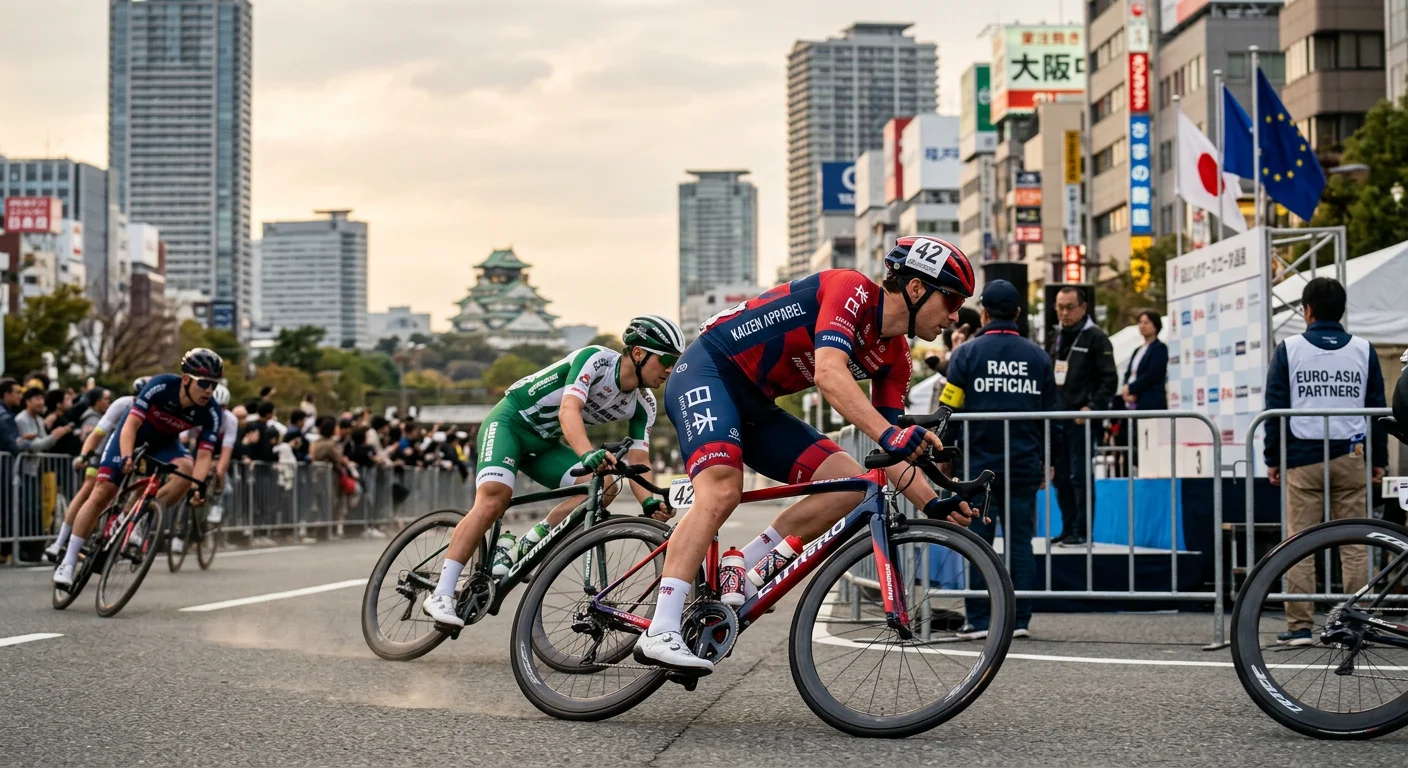
Cycling apparel has always been competitive — but compression cycling gear is rewriting the margin rules. The average branded cycling jersey clears 40–55% gross margin. Custom compression cycling apparel , positioned right, hits 65–80%. The brands winning this gap aren't the ones with the biggest budgets. They're the ones who spotted the opportunity first.
The global compression sportswear market is on track to surpass $7.6 billion by 2028. Inside that growth, muscle recovery cycling apparel stands out as one of the fastest-growing, least commoditized segments. That's where smart brands build real pricing power — the kind that's hard to compete away.
This isn't a surface-level trend report. You'll get a breakdown of actual cost structures, proven DTC playbooks, and supply chain mechanics. These are the factors that separate high-margin cycling brands from everyone else racing to the bottom.
Market Validation: Growth Indicators for Custom Compression Cycling Gear
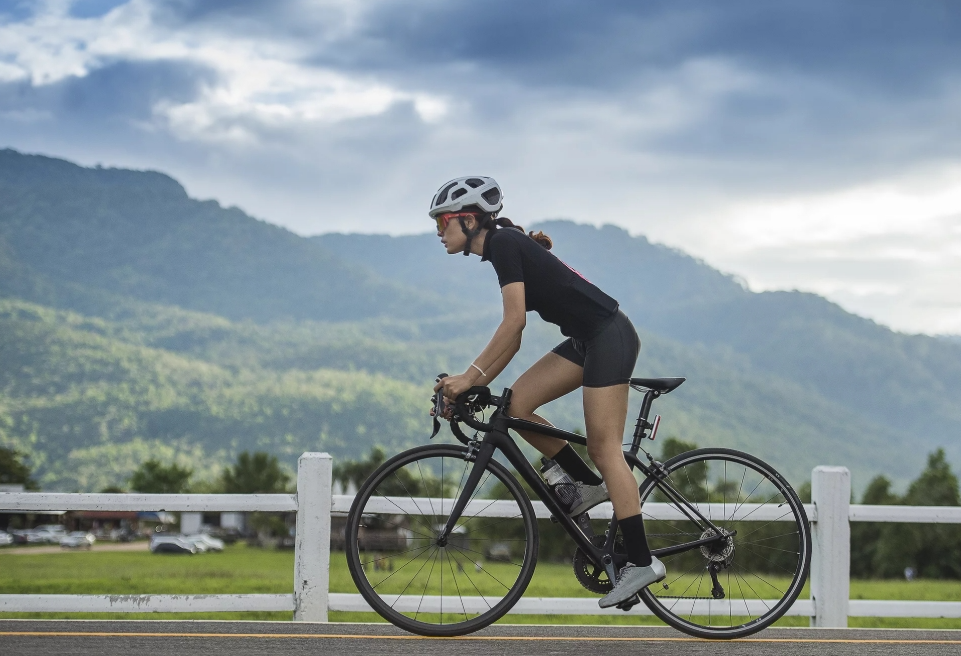
Three markets are moving in the same direction. Custom compression cycling gear sits right at their intersection.
Start with the numbers. The global custom cycling apparel market is valued at US$3.69 billion in 2024 . It's projected to reach US$6.24 billion by 2034 (5.8% CAGR). Add the broader cycling apparel market — set to grow from US$5.0 billion to US$8.1 billion by 2033 — and the case gets stronger. Then look at compression sportswear. It's outpacing both, expanding from US$4.8 billion in 2026 to US$11.2 billion by 2033 at a 12.8% CAGR .
That compression growth rate isn't random. Consumers are shifting toward performance-first gear. They're also willing to pay more for it. Most cycling brands haven't tapped into that pricing power yet.
What's Driving Demand
The growth comes from three clear buyer behaviors:
Identity-driven purchasing — Riders want gear that shows their personal style, team, or club. That fuels demand for sublimation printing cycling gear and custom cycling apparel colorways.
Bulk and event orders — Races, cycling clubs, and community events drive repeat, volume-based orders. These buyers come back. They're recurring revenue, not one-time customers.
Performance differentiation — More cyclists now separate standard kit from graduated compression sportswear built for muscle support and faster recovery. That gap is growing.
On the geographic side, North America holds 27.7% of the custom cycling apparel market . East Asia is growing at 6.8% CAGR . Both regions deliver above-average margins for branded compression shorts cycling — as long as you position the product at the right level.
The product anchor is clear. Jerseys and tops alone account for US$1.43 billion within custom cycling clothing in 2024. For brands looking at a lycra compression cycling bib or a compression jersey line, the market is already there. The premium end still has room — and not many players filling it.
Profit Architecture: Cost Structure, Retail Benchmarks, and Margin Comparison
Here's the number most cycling brand owners never see until it's too late: standard cycling jerseys top out at 60–70% gross margin in a well-run DTC operation. Compression and custom race gear? 65–80%+. That 10-point gap doesn't sound dramatic. Run it across 500 units at $180 retail, and it becomes the difference between a healthy brand and a struggling one.
Let's break down where those margins come from — and how to build them on purpose.
The FOB Cost Stack
Your cost structure starts at the factory. Here's what real OEM cycling clothing supplier pricing looks like across product tiers:
Standard bib shorts (non-compression): US$18–30 FOB per unit at 50–200 MOQ
Compression / race bib shorts: US$25–45 FOB — higher-denier performance cycling fabric technology , laser-cut straps, premium chamois
Full skinsuits (TT/criterium): US$40–70 FOB based on aero panel construction and zipper spec
Add 5–15% for freight and duties. That gives you your landed cost — your true baseline.
There's one more cost most brands miss: fixed development per style . Artwork, pattern work, Pantone matching, and pre-production samples run US$150–500 per design. At a 25-unit MOQ, that adds US$6–20 per piece. Reorder the same design twice and that number drops by half. By your fourth run, it's under US$5 per unit. Repeat orders make the math work in your favor.
DTC Pricing and the Margin You Capture
Here's where the cycling apparel markup strategy gets real:
Product | FOB Cost | DTC Retail | Gross Margin |
|---|---|---|---|
Standard club bib | US$18–30 | US$70–120 | 60–75% |
Branded compression shorts cycling | US$25–45 | US$140–220 | 65–80%+ |
Custom team set (jersey + bib) | US$35–55 | US$140–260/rider | 65–80%+ |
The custom cycling team set stands out. It runs on pre-order, so inventory risk drops hard. Net margins on these sets beat the e-commerce apparel average of 12–18% on a consistent basis.
Move 10% of your product mix from standard jerseys to lycra compression cycling bib or custom race kits. That shift alone can add 2–5 net margin points at the business level. That's not a tweak. That's a structural upgrade to your profit model.
Protecting Net Margin at Scale
High gross margin means nothing if operating costs eat it alive. Keep these numbers in check:
Keep total operating expenses below 30% of revenue — marketing, fulfillment, and overhead combined
Hold shipping and logistics to 10–15% of revenue — technical cycling garments run heavier than fast-fashion alternatives
Target ROAS above 2.8:1 and cap paid ad spend under 33% of revenue
Brands that hit these benchmarks land at 10–20%+ net margin — well above the 10% e-commerce average. That's not luck. You get there by building the cost stack right at every layer — FOB negotiation, channel mix, and order structure.
The brands running direct-to-consumer cycling brand models at 65–80% gross margin aren't doing anything unusual. They've built their cycling jersey profit margin into the product architecture before the first unit ships.
Pricing Strategy: How Customization and Fabric Technology Drive High Margins
Fabric upgrades and customization aren't just product decisions — they're margin decisions. Most cycling brands still don't treat them that way.
Here's how the math works. Moving from standard polyester-elastane to a denser-knit, high-elastane performance cycling fabric technology adds US$3–8 to your unit COGS. Apply a 4–6x markup — normal in premium technical apparel — and that small cost difference adds US$30–100 at retail. The numbers speak clearly:
Standard jersey: US$20 COGS → US$60 retail at 3x markup → 66.7% gross margin
Compression/aero jersey: US$24 COGS (+US$4 fabric upgrade) → US$120 retail at 5x markup → 80% gross margin
COGS went up 20%. Retail went up 100%. Margin expanded by over 13 percentage points. That's the real power of performance cycling fabric technology — a small cost increase, a large jump in perceived value.
Customization as a Price Multiplier
Sublimation printing cycling gear and logo personalization sit on top of the fabric premium. Digital and sublimation decoration costs stay under US$2–3 per unit . Yet they support 10–25% higher pricing because buyers connect uniqueness with quality. That's not random. Buyer psychology and production economics are working together here.
For branded compression shorts cycling , this plays out in two clear ways:
Team and club kits let you price at the full performance tier and lock in repeat orders at the same time
Limited-run colorways build urgency and hold your price firm — no discounting, no race to the bottom
Kit Bundling: The AOV Lever Most Brands Leave Untouched
Selling single items leaves money on the table. Set your product pages to default to full kits — jersey + lycra compression cycling bib + warmers + socks. This pushes average order value up by 40–60% , based on performance apparel bundle benchmarks. Your acquisition cost stays the same. Your revenue per order goes up.
Overhead is fixed per order. So every item added after the first one carries outsized profit. That's where a direct-to-consumer cycling brand builds a real margin edge over brands tied to wholesale.
Anchor Pricing to Protect the Premium
High-margin cycling brands share one pricing habit: they use a top-tier anchor . Put a fully customized, pro-grade graduated compression sportswear set at the top of your range. It makes your core compression line feel accessible — and you still clear 70%+ gross margin on it. Tiered pricing (entry, performance, pro) lets buyers choose their own level. Most will land in the mid and top tiers. That's where your cycling apparel markup strategy does its best work.
Guard those tiers with margin floors. A 1% price increase can shift operating profit by up to 8% . That means unplanned discounts on your compression line cost you far more than they seem to on paper.
Commercial Validation: DTC and Private Label Success Patterns
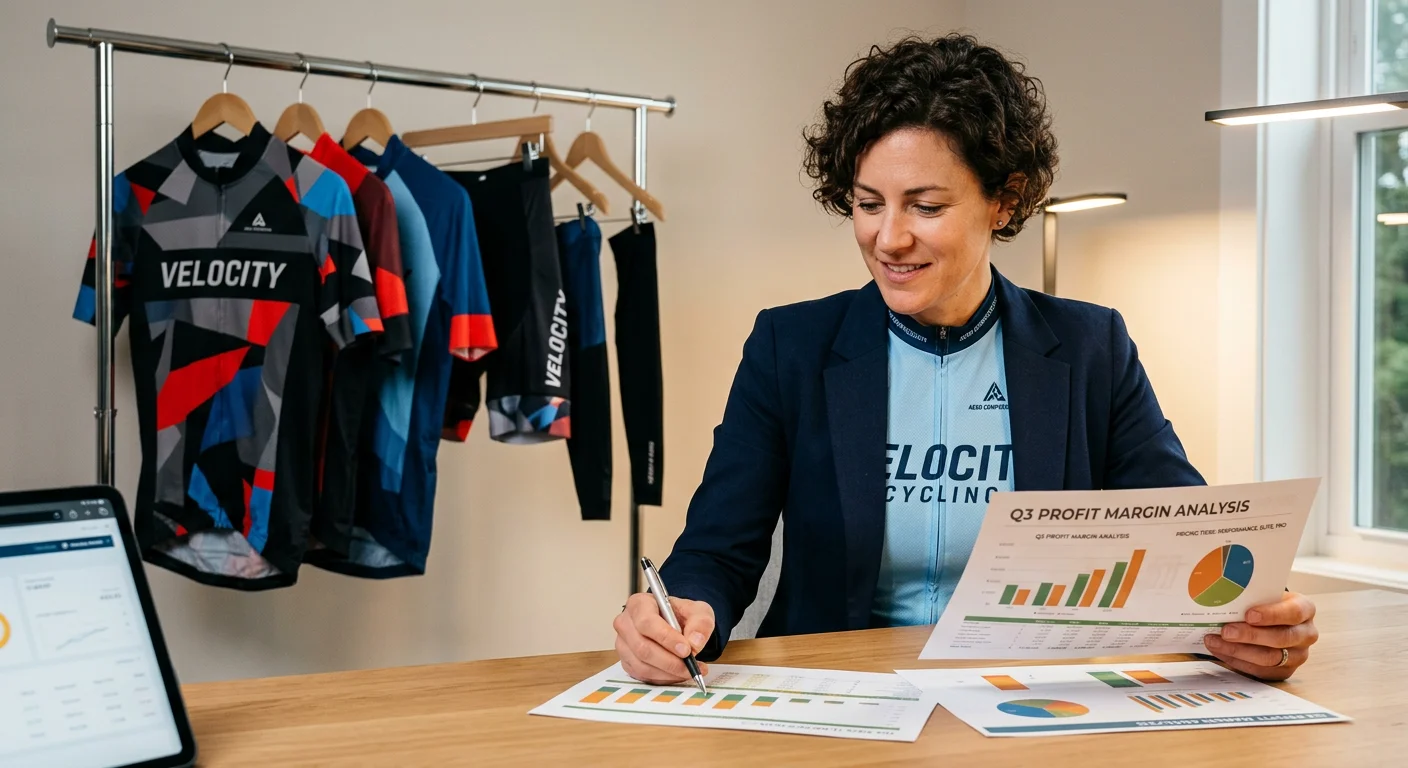
The brands building steady revenue in custom cycling compression wear aren't relying on luck or massive ad budgets. They run a repeatable commercial model. Any operator can prove it works inside 90 days — with the right structure.
The Team and Club Account Is Your Fastest Proof Point
Don't chase individual consumers at launch. Go straight to cycling clubs, racing teams, and triathlon squads. That's where commercial validation happens fastest.
Here's why it works: one team account of 40 riders ordering a jersey plus lycra compression cycling bib generates USD 5,000–15,000 per order . That's not a one-time sale. That's a recurring annual account. Teams refresh designs every 1–2 seasons — they have to reorder. Plus, once sizing blocks are confirmed with a club, 60–80% of members rebuy the same brand the following season .
Lock in 10–30 active team accounts . Hit a 70–80%+ re-sign rate year over year. At that point, you're not running a cycling apparel business. You're running a subscription-model sporting goods brand — you just don't call it one.
The lifetime value adds up fast. A single club relationship tracked over 3–5 years is worth USD 20,000–100,000+ once accessories, winter kit, skinsuits, and new member orders stack on top. Your OEM cycling clothing supplier relationship pays for itself many times over on accounts like these.
Validate With ODM First, Invest in Proprietary Later
The most common mistake new direct-to-consumer cycling brand operators make: building proprietary patterns before proving demand. That's backwards.
Start with a white-label or ODM cycling apparelfactory. Modern suppliers focused on performance cycling fabric technology carry established size blocks and grading built across thousands of orders. You get their fit credibility from day one. The practical result:
Size-exchange rates under 5% on your first season — critical for protecting margin and reviews
Time from concept to shippable product: 2–3 months
MOQs as low as 10–25 pieces per SKU on custom graphics — you get real sell-through data without tying up too much capital
Get your annual volume on key styles past 500–1,000 units . Let gross margins settle at 50–60% . Then put money into proprietary tech packs and custom fit blocks. That's the point where better FOB pricing becomes something you can negotiate — and product differentiation becomes something worth defending.
The Commercial Thresholds That Count
Not all traction signals are equal. These metrics tell you whether you've built something solid or something fragile:
Metric | Target Benchmark |
|---|---|
CAC payback period | Under 6 months (often achieved on first bulk order) |
Repeat purchase rate (12 months) | 30–40%+ at team/account level |
Gross margin on small-batch custom runs | 50–55% minimum (50–100 pieces per style) |
Return rate on performance kit | Under 5–7% once fit blocks standardize |
Revenue from returning organizations (mature stage) | 70–85% of total revenue |
Those numbers holding steady means the business model is validated. Not before.
One last lever most brands leave on the table: the online configurator . Swap physical sampling for 3D mockups. Your cost-per-new-team acquisition drops to USD 150–250 instead of USD 500–1,000. Decision cycles shrink from months to 1–3 weeks . On a USD 5,000+ team order, your blended CAC falls below 5–10% of revenue . That's not a design tool. That's a sales engine.
Supply Chain Blueprint: OEM Vetting, MOQ Negotiation, and Production Workflow
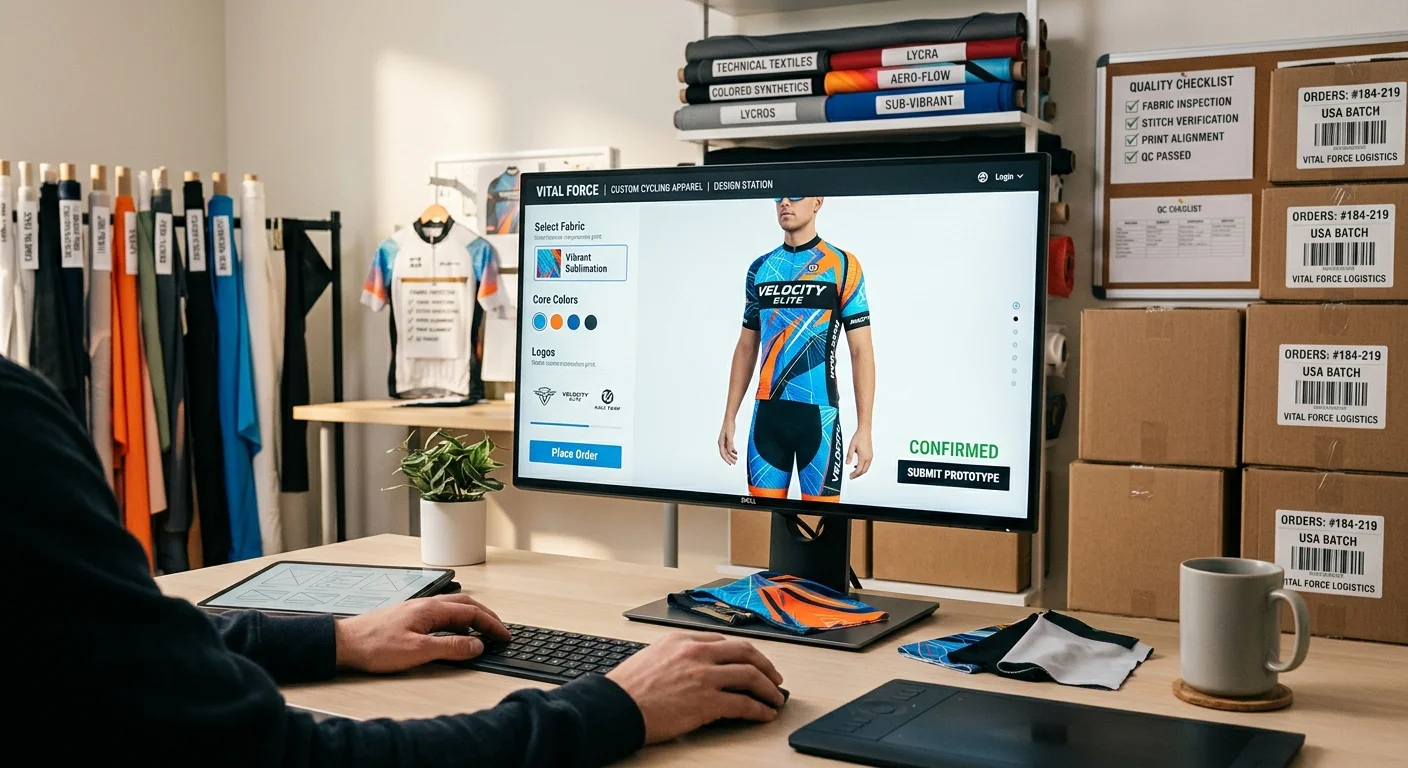
A broken supply chain is the fastest way to kill a high-margin cycling brand — even one with a great product concept and a ready market. The good news: most competitors are making the same sourcing mistakes. Fix yours, and your operational edge grows every quarter.
Here's how to build it right.
Step 1: Vet Your OEM Like You're Hiring a Business Partner
Not every factory that claims to produce performance cycling fabric technology truly understands compression garment engineering. The gap between a capable OEM and an average one shows up in your return rate, your review scores, and your margin.
Run every prospective OEM cycling clothing supplier through these four filters before spending a single dollar:
Sublimation and fabric performance
Ask for print samples on the actual fabric — high-denier nylon/elastane, not cotton test swatches. You want 120–200+ DPI continuous tone with zero color banding across stretch zones (shoulders, thighs). Request wash-fastness test results: grade 4 or above after 20 wash cycles against ISO 105-C06 is the baseline. Anything lower means your sublimation printing cycling gear fades before the customer's second season.
Compression construction standards
Flatlock or 4-needle 6-thread stitching on inseams, bib straps, and shoulder seams should be their default — not an upgrade you have to request. Ask for proof of compression mapping experience. A factory that shows articulated knee panels and graduated quad compression patterning on past work is a different class of cycling apparel supplier from one printing club jerseys in bulk.
Chamois sourcing transparency
The chamois is where most budget factories cut corners — and where your customers feel it most. Require confirmed sourcing relationships with established Italian pad makers: Elastic Interface, Dolomiti, La Fonte. Ask for spec sheets showing multi-density foam (60–120 kg/m³ range) and antibacterial treatment. Request OEKO-TEX Standard 100 Class II certification on pad materials. No documentation means no deal.
Compliance documentation
Check for valid ISO 9001 certification — verify the issuing body and expiry date. You also need OEKO-TEX Standard 100 for body fabrics and gripper elastics, plus a third-party social or quality audit — BSCI, SMETA, or equivalent — from the last 12 months. These aren't just ethical checkboxes. They protect your brand when a wholesale buyer or marketplace asks for compliance proof at scale.
The reference check most brands skip
Ask for a portfolio of at least 3–5 DTC or club clients with full-custom lycra compression cycling bib or kit work. Then call or email at least one reference. Two numbers matter most: on-time delivery rate (target ≥ 95% over the past year) and defect/return rate (target < 2–3% for stitching and fabric issues). A factory that refuses to provide references doesn't trust its own track record.
Score every supplier using a weighted table:
Criteria | Weight |
|---|---|
Sublimation quality & stretch-fastness | 25% |
Compression patterning & fit expertise | 20% |
Certified chamois sourcing | 15% |
OEKO-TEX & ISO 9001 documentation | 15% |
DTC/club references & after-sales support | 15% |
Lead time & on-time delivery record | 10% |
Score every factory the same way. Gut feel is not a sourcing strategy.
Step 2: Negotiate MOQ Like a Growth-Stage Brand, Not a One-Time Buyer
Here's the leverage most new brands overlook: factories don't want your first order. They want your tenth. Position yourself as a growth account. That changes the entire MOQ conversation.
Your target opening position: 10–30 units per design, per cut (men's bib, women's bib, jersey), per colorway. That's your launch capsule. Most capable factories producing branded compression shorts cycling can hit this — provided you frame the conversation the right way.
The frame that works: present a 12-month rolling forecast. Show them 30 units now, 60 in Q2, 120 by Q4. You're not asking for a favor. You're making a business case for flexibility. Factories that see a growth trajectory give you room. Factories that see a one-time buyer protect themselves with high MOQs.
Build in tiered pricing from the start. Don't accept a single flat price quote. Push for a clear laddered structure:
10–29 units: base price
30–49 units: 5% reduction per unit
50–99 units: 8–10% reduction
100+ units: 12–15% reduction
This structure gives you a clear roadmap for how your cycling jersey profit margin improves as volume grows. It also pushes you to consolidate designs rather than scatter your line across too many colorways.
Three consolidation tactics that lower your effective MOQ:
Share base fabrics across SKUs. Use the same primary nylon/elastane construction for both bibs and jersey side panels. Pooled material use means the factory hits its fabric minimum faster — so your per-style MOQ drops.
Limit colorways at launch. Two hero designs, not five. Each extra colorway splits your volume and pushes every SKU closer to the factory's minimum. Focus first, expand after you validate.
Accept in-stock fabric for run one. Black, navy, charcoal — standard colors the factory already holds in inventory. You skip upstream fabric MOQs and unlock 10–30 unit runs that custom-dyed fabrics of cycling apparel can't match.
On samples and tooling: negotiate 1–2 development samples plus one pre-production sample per style. Get the sample cost credited 100% against your first bulk PO once you hit the agreed MOQ tier. Confirm in writing that your sublimation print files, graded patterns, and pad mould selections are yours to keep on reorders — unless the design changes.
One exception worth noting: ordering custom-dyed graduated compression sportswear fabric or an exclusive silicone gripper mold? Accept the higher fabric-level MOQ — but push for a draw-down structure. The factory holds the stock. You pull it across multiple smaller POs over 6–12 months at a locked unit price. Your cash exposure stays low without losing the custom spec.
Step 3: Understand the Fabric Stack Before You Write a Single Tech Pack
Factories producing high-performance muscle recovery cycling apparel don't work from generic patterns. They engineer compression zones by muscle group. You need to speak that language to get the right product built.
Primary body fabric for bibs and compression shorts:
- 78–85% high-tenacity nylon (6.6 or similar) for abrasion resistance and shape retention
- 15–22% elastane for graduated compression and four-way stretch
- Target 200–250 g/m² for race bibs; 250–280 g/m² for high-compression or long-ride use
- Stretch ≥ 150–180% in both warp and weft; recovery ≥ 90–95% after 50% extension
Jersey construction:
- 120–150 g/m² polyester or nylon/poly mix for front and back panels — lightweight with high breathability
- Sleeves and side panels in a compressive or textured knit to stabilize muscles and cut aerodynamic drag
Grippers and edges:
- Laser-cut hems on leg and sleeve openings wherever possible
- Seamless silicone gripper bands — 3–5 cm width on leg openings, OEKO-TEX-compatible silicone formula
These are not premium upgrades. For any product positioned as performance cycling fabric technology , they're the baseline. Build them into your spec from day one. Adding them after your first production run costs more time and money than you want to spend.
Step 4: Run the Production Workflow Like a System, Not a Series of Emails
From tech pack to your first DTC shipment, production runs through six stages. Each has a specific failure point. Know them before you start.
1. Tech pack creation
This is where most brands waste time and money. A complete tech pack for a lycra compression cycling bib covers: panel breakdown with compression zone specs (higher modulus fabric on quads, lighter on waist), fiber content and fabric weight per panel, stitch type and thread spec at every seam, pad model codes with placement coordinates, finished garment measurements and tolerances (±1.0–1.5 cm on chest, waist, inseam), and full labeling requirements including country of origin. Vague tech packs produce vague samples. Be precise.
2. Digital mockup validation
Before cutting any fabric, get 3D garment simulations over a cyclist avatar. Check panel line placement, logo positioning, and print registration on stretch zones. Approve all colors via Pantone codes and digital proofs — not screen-based guesses.
3. Physical samples and fit testing
Round one: a proto sample in your middle size. Check fabric handfeel, compression feel, and pad placement. Round two: a full size run (XS–XL or your target curve) tested by riders who match your actual customer profile. Race-fit athletes and club-fit recreational cyclists have very different tolerance for compression tightness and bib strap tension. Collect structured 1–5 ratings on strap comfort, knee bunching, leg gripper pressure, and torso length. Those ratings become your revision brief.
4. Pre-production approval (PPA)
The factory builds one final sample using production-run fabrics, pads, trims, print files, and machines. You sign off on measurements against your tolerance table, color consistency against jersey and bib matching, and workmanship — seam alignment, silicone application uniformity, laser-cut hem quality. Nothing moves to bulk without written sign-off.
5. Bulk production
Lock your final PO with size breakdown and tiered pricing confirmed. Standard lead time for quality OEM custom compression cycling gear: 45–60 days from PPA approval. Require in-line inspection during sewing and assembly, plus a final AQL inspection before shipment. Get the inspection report with defect rates broken down by type. That data protects you in any dispute.
6. QC, shipment, and DTC readiness
Pre-shipment QC covers fabric and print defects (ghosting, mis-registration), seam pull-test results on high-tension areas, pad centering and attachment, and correct labels, hangtags, and packaging. For your first launch batch, consider a split shipment: air freight for 30–50 units to hit your launch date, sea freight for the rest. Label cartons by style, color, and size with barcodes if you're running 3PL fulfillment. Keep retain samples from every batch — they're your reference standard for future reorders and your proof baseline if warranty issues come up.
The brands building strong direct-to-consumer cycling brand businesses at high margins aren't running this on instinct. They treat supply chain documentation with the same discipline they bring to marketing. Set up this system once. Each reorder gets faster, cheaper, and more predictable — and your cycling apparel markup strategy gets stronger with every production run.
Differentiation Launchpad: Three High-ROI Entry Points for Brands
Most cycling brands compete on the same axis — faster, lighter, more aerodynamic. That's a race to commodity pricing. The brands building 70%+ gross margins are doing something smarter. They enter the market from a different angle.
Here are three proven entry points that expand your pricing power — no larger product catalog needed.
Entry Point 1: Reframe Compression Gear as Recovery Equipment
Stop selling apparel. Start selling recovery.
Put a graduated compression sportswear bib next to foam rollers and massage guns in a buyer's mind. Price sensitivity drops. That's not theory — it's buyer psychology. Recovery tools don't get compared to jersey prices. They get compared to PT sessions and sports massage.
Here's how to execute this commercially:
Bundle a "regeneration kit": compression bib shorts + recovery calf sleeves + a structured post-ride protocol (PDF + video). DTC fitness bundles with digital components carry 20–40% price premiums over standalone apparel.
Target AOV shift: from a single-item USD 150–220 to a kit-based USD 260–420.
Product spec that supports the story: graduated compression targeting quads, hamstrings, calves, and glutes — with a post-ride comfort window of 2–4 hours. Your muscle recovery cycling apparel needs to function off the bike, not just on it.
The off-season angle matters too. Race-kit demand softens between event cycles. Recovery positioning keeps full-price demand alive year-round. It anchors to training and regeneration — not race calendars.
Entry Point 2: Capture Athleisure Margin With Urban-Crossover Design
Branded compression shorts cycling built for race performance alone leaves money on the table. A rider who wears the same piece from the saddle to the café — or the office — pays athleisure prices, not performance-kit prices.
That margin gap is real. Lifestyle and commuter cycling SKUs carry 20–40% higher gross margin than pure race kit. Fashion positioning drives this. So does lower end-of-season discounting.
The design decisions that open up this pricing:
Matte-finish lycra — less "race shine," more premium athleisure texture
Hidden commuter pockets — phone, transit card, keys, without breaking the silhouette
Tonal reflective detailing — visible in headlights, invisible at brunch
Muted colorways — earth tones and city neutrals, not race neons
Price ladder for this segment:
- Base commuter short: USD 120–160
- Matte-finish compression short with hidden pockets + reflective: USD 160–220
- Limited capsule colorways: add 10–20% premium on top
That capsule and color-drop structure cuts the discount spiral. Scarcity holds price.
Entry Point 3: Geometry-Specific Fit + On-Demand Production
Standard e-commerce cycling apparel returns run 20–40% with poor fit. Every returned unit costs you margin twice — once on fulfillment, once on restocking or markdown.
The fix: a geometry-tuned fit system paired with batch-on-demand production.
Here's what this looks like in practice:
An online fit tool takes rider height, weight, bike geometry (race vs. endurance stack and reach), and position preference. It maps those inputs to specific panel combinations — long-torso jersey, short-leg lycra compression cycling bib , adjusted back panel tension.
2–3 panel variables per style: sleeve length, leg length, torso adjustment (±2 cm). Enough personalization to feel custom. Limited enough to stay manufacturable.
Micro-MOQ production runs of 1–20 units per configuration , with 7–21 day lead times — no dead stock, no end-of-season markdowns.
The margin math is direct. Say 30% of a conventional line sells at 40% off. Shifting those units to on-demand at full price delivers an effective ~12%+ margin uplift on total line revenue. That's before repeat purchase lift — better fit drives 10–20% higher repurchase frequency in performance apparel categories.
Pricing structure for geometry-tuned fit:
- Standard (S–XL stock): base price
- Geometry-tuned (online fit tool, made-to-order): +20–30% premium
- Pro custom (team micro-batches with sublimation printing cycling gear branding): B2B tier pricing
These three entry points don't require a product line overhaul. They require a positioning decision — and the supply chain discipline to execute it. Each one moves your direct-to-consumer cycling brand into a context where buyers focus less on price and more on value. That's where sustainable margin lives.
Conclusion
The math doesn't lie. Custom compression cycling gear delivers margin structures that generic activewear can't touch. Market timing favors brands ready to act now.
Here's what separates brands that win this opportunity from those that miss it. Stop treating lycra compression cycling bibs and performance pieces as commodity products. Start building them as premium, story-driven assets with price points you can defend.
Fabric technology, fit customization, and sublimation printing aesthetics aren't just production details. They're your margin multipliers.
You have the profit model. You have the market data. You have the supply chain roadmap. The real question is execution.
Start with one product. Vet one OEM cycling gear supplier. Set your positioning before you set your price. The brands winning this category didn't build everything at once — they built the right thing first.
Your high-margin cycling line isn't a someday strategy. It's a Q-next-quarter decision.