Sourcing Made in Italy cycling wear is more than a supply chain decision. It's a brand identity commitment. That choice shapes every conversation — with a retailer, a sponsored athlete, or a customer opening their first kit.
The problem? Italy's manufacturing landscape is hard to read on purpose. The best factories don't run Google Ads. Their websites are often an afterthought. A cold email to the wrong contact goes nowhere.
The details that matter most — MOQ thresholds, real lead times, which facilities still cut and sew in-house versus sending work to Eastern Europe — stay buried in relationships and industry conversations. Most brand founders never get that access.
This guide changes that. We've mapped out the production capabilities, minimum order thresholds, and client profiles of the Italian cycling apparel manufacturers worth knowing. So you can walk into your first supplier conversation already knowing who you're dealing with.
Santini Cycling (Santini Maglificio Sportivo)
Sixty years in Bergamo leaves marks — on fabric, on process, on knowledge that never gets written down.
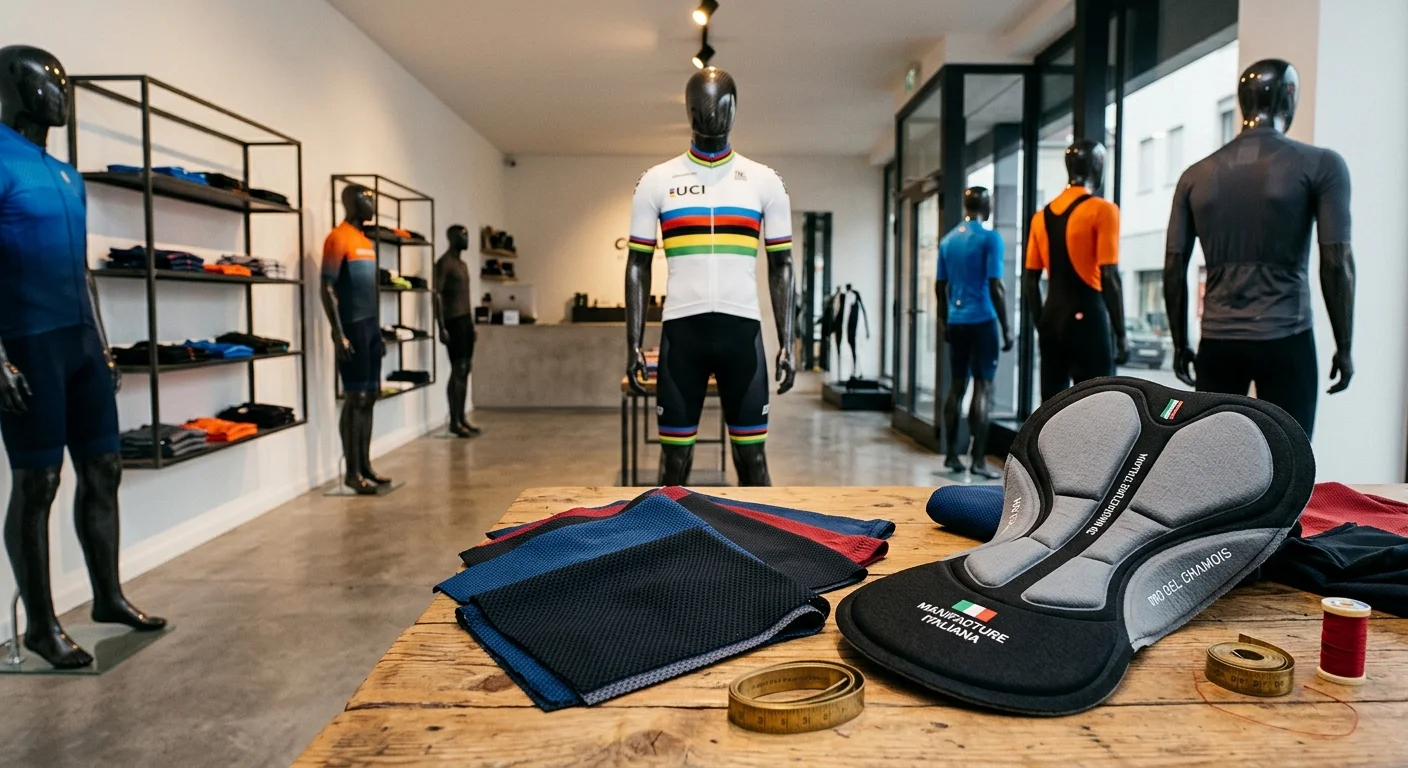
Pietro Santini founded this Lombardy-based manufacturer in 1965. Since then, Santini has built what Most cycling apparel suppliers can't match: genuine elite racing credibility. Since 1988, Santini has supplied the UCI rainbow jersey — the most recognized garment in professional cycling. That's not a marketing claim. It's a technical responsibility.
The production numbers speak for themselves. Santini makes more than 7,000 items per day . 80% of that output ships to international markets . For 2024, revenue estimates land around $13.9 million , with a team of 103 employees . This is a focused, mid-scale manufacturer — not a high-volume commodity factory.
Their core strengths sit in two areas:
- In-house materials research
- Chamois development
Both matter most for bibs priced above the €150 retail threshold . At that level, cut corners show.
Is It the Right Fit for Your Brand?
Santini runs a dedicated custom and teamwear channel . That's your entry point for B2B inquiries. Past clients include Trek-Segafredo and Ironman — names that signal comfort with high-spec, performance-driven projects.
MOQ thresholds and price bands aren't listed publicly. Budget for a premium-level conversation from the start. Few factories carry the UCI association. So for brands that need that credibility anchor, the options narrow fast.
runcyclingapparel.com
The contact page phone number starts with +86. That alone tells you where this operation is based.
Runcyclingapparel .com calls itself a 15+ year OEM/ODM cycling apparel manufacturer. The product range covers custom jerseys, bib shorts, jackets, and the full kit. You start at 50 pieces minimum. Production runs 20–30 days, and wholesale pricing sits in the $45–$65 per unit range for mid-grade builds. Discounts are tiered across three order bands:
50–200 units
200–500 units
500+
The sourcing content on the site is worth reading. It breaks down exactly what makes up your unit cost — fabric takes 40–45% of the unit price , factory margin runs 12–20% , and setup fees fall below $0.50/unit once your order clears 51–300 pieces. For quote comparisons, the site suggests adjusting against DDP pricing by subtracting 10–18% . That's practical, specific cost guidance. Most suppliers don't publish that kind of detail.
Technical targets are spelled out too:
180–220 GSM for performance jerseys
85% polyester / 15% spandex fabric blends
Colorfastness at Grade 4 or higher on sublimation prints
What It Is
This is a China-based sublimation cycling jersey manufacturer . It is not an Italian production facility. Italian Lycra does get mentioned in the content — but that's a fabric sourcing reference, not a claim about where the garments are made.
For brands that need cycling apparel OEM ODM with low MOQs and clear cost breakdowns, this is a solid starting point. For brands building a Made in Italy cycling wear identity, it's the wrong fit.
Know the difference before you send the inquiry.
Giordana Cycling
Founded in 1979 in Veneto, Giordana has spent four decades building something most Italian cycling wear manufacturers can only envy. It holds a dual identity — respected in elite racing and trusted in business sourcing alike.
The product lineup breaks into four clear tiers. This structure makes B2B sourcing decisions straightforward. Each tier — NX-G , FR-C Pro , SilverLine , and Fusion — maps to a specific price point and customer type:
NX-G Core Collection — maximum compression, aerodynamic paneling, elite race fit. Use this as your anchor SKU for bibs priced above €200 retail.
FR-C Pro — race-ready, pro-issue construction. This is the go-to tier for sponsored team kits and high-performance club orders.
SilverLine — strong performance credentials with a less aggressive fit profile. Good middle ground for club riders who want quality without the full race fit.
Fusion — relaxed fit, built for everyday training use. Made in Italy at a value-engineered price point.
All four tiers connect to Giordana Custom — their dedicated B2B channel for teams, clubs, and branded kit programs.
Contacting Giordana Custom
MOQs and lead times aren't listed publicly. Plan for 5–10 pieces per style on top-tier lines and 15–25 pieces on Fusion-level builds. Production runs 5–8 weeks after design approval. Add another 1–3 weeks for prototyping.
Start by filling out the Giordana Custom quote form . Bring your collection preference, size run, and artwork. No artwork yet? You can request design assistance through the same channel.
Best match: growth-stage brands building a credentialed Italian road kit across multiple price tiers.
De Marchi
Founded in 1946 in the Veneto, De Marchi holds a corner of Italian cycling apparel that almost no other manufacturer can claim: heritage wool construction with genuine artisan provenance .
This isn't a factory that scaled up to chase volume. The brand built its identity around merino-blend jerseys, classic race-fit bibs, and vintage-inspired collections. These pieces sell at Eroica without a marketing budget. The audience finds them on its own.
Where it fits for B2B sourcing:
MOQ: 80–200 pieces per style, per colorway. Custom merino of cycling apparel runs push toward the 200–300 piece threshold.
FOB pricing: Heritage wool jerseys land around €100–€150/piece . A jersey-and-bib wholesale set runs €160–€230 combined , depending on pad tier.
Lead times: 3–4 weeks for sampling. Bulk production runs 8–12 weeks — longer for custom yarn-dyed merino or embroidery.
The chamois spec uses Italian-sourced pads built for 6–8 hour endurance rides . That's a real spec difference worth noting.
Who Should Be Talking to De Marchi
Your brand needs to be building a collector-tier or heritage-positioned road line — limited numbered jerseys, race anniversary editions, or lifestyle-adjacent cycling labels. Your brand story sits somewhere between classic Italian cycling culture and modern premium retail. De Marchi fits that space naturally.
For high-volume sublimation kit programs, look elsewhere.
Capo Cycling
American design sensibility, Italian hands. That's how Capo has operated since 2004.
The structure is clear. Design and development happen at the US headquarters. The actual cutting, sewing, and finishing — the work that earns the handcrafted in Italy label — takes place in northern Italy's production facilities. Two locations, one product. Capo handles design in-house and sends production to Italy. This keeps quality high while allowing faster design updates.
Their custom program covers the full kit: jerseys, bib shorts, jackets, vests, speedsuits, and accessories . The client list includes teams, clubs, retailers, corporations, and event organizers. That's a wider commercial reach than most Italy-based cycling apparel suppliers go after.
What You Won't Find Listed
MOQ thresholds, FOB pricing, and lead times aren't posted anywhere. Capo doesn't offer a sourcing page with open details. Your starting point is their custom apparel and team program inquiry channel.
Best match: brands that want Italian manufacturing credibility paired with US-market design fluency . This suits brands selling into North American or Australian retail that still want to hold onto the Made in Italy positioning.
Nalini Sport (B2B & OEM Division)
Sixty years of dressing professional cyclists builds a rare kind of knowledge. It lives in a pattern cutter's hands — not in a spec sheet.
The Nalini brand is backed by MOA Sport (Manifattura MOdenese Abbigliamento Sportivo), based in Castel d'Ario, Mantua province. MOA runs a fully vertical operation. They control every stage in-house — yarn spinning, knitting, dyeing, large-format sublimation printing, cutting, sewing, and finishing. Every step stays under one roof.
Their client list carries real weight. Astana and Cofidis race in Nalini kit. The Saudi Cycling Federation named them as the official national cycling team apparel supplier. These are not marketing deals. UCI-sanctioned race wear must meet strict compliance standards — there is no room for failure.
For B2B sourcing, the range Nalini covers is a key advantage. You can order entry-level club kits or go all the way up to Black Label construction — the same build used in their WorldTour pro kit . Same facility, same sublimation lines. The material tier is what changes.
Practical benchmarks for planning:
MOQ: ~10–25 pieces per design at club level; 100–500+ for brand or federation programs
Sampling: 2–4 weeks after design approval
Bulk production: 4–8 weeks after final sign-off
FOB pricing reference: €70–€120 per jersey/bib kit at volume
Who Should Pursue This
This works best for growth-stage and established brands that want to build a professional cycling team apparel supplier story with real WorldTour proof behind it. The entry point depends on your region. Nalini USA handles North American inquiries. For everything else, reach out directly to Nalini's Italian commercial team.
Sportful (Custom & Team Division)
Sportful doesn't ask you to trust the Made in Italy label. It asks you to look at the race results.
Sportful is part of the Manifattura Valcismon group — which also owns Castelli and Karpos. They've been cutting kit for professional cycling and cross-country ski champions since the mid-20th century. Digital customization partner Unmade puts it straight: "a global leader of the cycling jersey offer for cycling teams and professionals." That's not marketing talk. That's a track record built over decades.
What sets Sportful apart for B2B sourcing is the order structure. Two entry points:
"By You" — no minimum, one piece, all digital. Good for sampling or athlete gifting.
"Clubs" — structured teamwear runs, 15–30 pieces per style at competitive pricing, scaling to 500+ for events or federations.
Both paths run through UnmadeOS , their on-demand configurator. You handle design, logo placement, size matrix, and checkout online. No account rep needed for standard orders.
Practical Numbers to Plan Around
MOQ: 1 piece (By You) / ~15–30 pieces (Clubs)
Sampling: ~2–3 weeks after design approval
Bulk production: 5–7 weeks from sign-off
B2B pricing benchmark: ~€85–€125 per jersey and bib combo at club volume
Best match: Growth-stage brands that want WorldTour pattern credibility with a clean, digital ordering process. Start small, then scale up as your volume grows.
Montella Cycling
Italian-American founders. Italian fabrics. A US phone number. Montella Cycling sits at a unique crossroads — and that position matters before you reach out.
The brand runs two direct-to-consumer stores (montella-cycling.com and .eu). Both focus on affordable performance road apparel. Their jerseys use 140 GSM long-weave polyester — lightweight, moisture-wicking, and soft against skin in hot weather. The fabric comes from Italy. The brand story is Italian-American. But where the cutting and sewing take place? That detail isn't shared on the site.
One area Montella handles well: sizing . Men's pieces go up to 6XL . Women's reach 5XL . Most styles cover nine sizes total. That's rare in road cycling apparel. It reflects a clear design choice — gear built for riders who don't fit the ex-pro body type.
What This Means for B2B Buyers
No OEM or private label program appears anywhere on the site. No MOQ, no lead times, no B2B pricing — none of it is listed.
That doesn't mean the door is shut. It means you need to start the conversation yourself.
Email: info@montella-cycling.com — ask for the production or sourcing contact by name or role
Phone: +1 407-479-8727 — good for quick initial screening
In your first message, cover three things. Ask whether they take OEM or private label projects. Confirm where the factory is located. Request MOQ numbers and sample lead times.
Best match: Brands looking for inclusive-sizing road kits backed by Italian fabric sourcing — but check the manufacturing details before you commit.
Italian OEM Manufacturer Comparison Matrix (Decision Framework)
Eight Italian OEM cycling apparel manufacturers. Four decision variables. One table that cuts through months of supplier emails.
The hardest part of sourcing Italian cycling apparel isn't finding names — it's knowing which name fits your situation. A heritage wool project and a sublimation club kit program don't belong in the same conversation, with the same factory, in the same season.
Here's the framework that fixes that.
The Core Comparison Table
Manufacturer | MOQ (per style) | FOB Reference (jersey + bib) | Lead Time | Best Match |
|---|---|---|---|---|
Santini | 10–15 pcs | €95–€150 | 8–12 weeks | Pro-level aero, UCI credibility |
Sportful | 15–30 pcs | €85–€125 | 6–8 weeks | WorldTour-backed performance brands |
Nalini (MOA Sport) | 20–30 pcs | €70–€120 | 4–8 weeks | Growth brands needing full ODM pipeline |
Giordana | 10–25 pcs | €65–€115 | 6–8 weeks | Multi-tier brands, club through pro |
De Marchi | 80–200 pcs | €100–€150 | 10–12 weeks | Heritage positioning, merino, collector editions |
Capo | 15–25 pcs | €75–€115 | 6–9 weeks | US-market brands, Italian production credibility |
Montella | 5–10 pcs | €65–€90 | 30–40 days | Early-stage brands, inclusive sizing, low-risk testing |
runcyclingapparel.com | 20–50 pcs | $45–$65 | 20–30 days | Fast private-label, non-Italian origin |
All FOB ranges reflect volume at 30–150 pieces. Final pricing depends on fabric tier, chamois spec, zipper grade, and print complexity.
Three Decision Triggers
Trigger 1 — Speed and low commitment matter most
MOQ under 50 pieces. Delivery inside 45 days. You're testing product-market fit, or launching a first collection without heavy capital tied up.
Montella — 5–10 piece minimums, 30–40 day turnaround for standard sublimation. Italian fabric sourcing. The easiest entry point on this list.
Nalini — moves faster than its pro reputation suggests. Club-level orders at 20–30 pieces can reach your door in four to six weeks.
Trigger 2 — UCI association and aero credibility are non-negotiable
Your brand story lives or dies on professional racing legitimacy. You're targeting serious athletes, race-day retail, or sponsored team contracts.
Santini — UCI rainbow jersey supplier since 1988. No other manufacturer on this list holds that record.
Sportful — BORA-hansgrohe kit supplier, aerodynamic pattern library tested at race speed. Their Clubs or By You structure keeps entry accessible for smaller orders.
Trigger 3 — Premium price point, heritage narrative
Your retail pricing sits above €150. The product needs a story that justifies the tag.
De Marchi — founded 1946, Bassano del Grappa. Merino construction, 6–8 hour chamois spec, limited numbered editions. This holds €150–€250 retail price without discounting pressure.
Capo — Italian production, US design sensibility. A clean fit for brands selling into North American premium retail that still need the Made in Italy anchor.
How to Score Your Own Shortlist
Score each candidate against five weighted criteria. Assign 1–5 based on your specific brief:
Criteria | Why It Matters |
|---|---|
Pro-team / UCI involvement | Validates price premium with buyers and athletes |
MOQ flexibility | Shows whether you can test before scaling |
Full ODM capability | Cuts your internal design burden — patterns, grading, chamois spec |
Lead time reliability | Seasonal launches don't wait for slow factories |
Heritage / brand halo | Affects co-branding appeal and retail conversation |
The manufacturers with the highest combined scores across your top three criteria become your shortlist. Reach out to all three at once. Italian factories respect brands that show up prepared — with a clear brief, a target price band, and a real timeline.
Supplier Matching Strategies by Brand Lifecycle Stage
The factory that launches your brand will not be the one that defines it.
That's not a failure. That's how sourcing works. A supplier relationship that fits at 200 units per year turns into a bottleneck at 2,000. Knowing which stage you're in — and picking the right factory for that stage — is the real skill.
Stage 1: Startup Phase (Under 1,000 Units/Year)
You don't need a perfect factory. You need a fast one.
At this stage, focus on prototyping speed, low-MOQ tolerance, and design flexibility — not production line sophistication. Look for suppliers who work from standard size blocks. Skip custom pattern development for now. Every custom pattern adds cost you don't need yet.
What to ask for:
- MOQ of 20–30 units per style
- Fabric swatch library access before sampling — narrow your material choice first
- Lock one jersey + one bib to start, nothing wider
- Standard blocks, not custom grading
Best-fit suppliers at this stage: Montella Cycling, Giordana (Club Division)
Score your candidate on: MOQ, sampling turnaround, pattern-change cost, fabric library depth.
Stage 2: Growth Phase (1,000–5,000 Units/Year)
Volume exposes every weakness your supplier hid during sampling.
You need batch-to-batch consistency, seasonal capacity reservation, and integrated sublimation-plus-cut-and-sew capability. These aren't optional anymore. A factory that nailed your first 50 pieces can still fall apart at 300 — especially if their QC process isn't documented and repeatable.
What to build in now:
- Standardized tech packs — so reorders don't require renegotiation
- Contracted seasonal allocation booked in advance
- Volume pricing at the 100–250 units/style tier
- 4–6 week lead time windows locked for planned drops
Best-fit suppliers at this stage: Nalini Sport, Capo Cycling, Sportful (Team Division)
Score your candidate on: defect rate, repeatability, capacity reservation, lead time reliability.
Stage 3: Mature/Pro-Team Phase (5,000+ Units/Year or Team Sponsorship)
At this level, the supply relationship stops being transactional. It becomes a development partnership.
You need suppliers who can handle exclusive fabric co-development, UCI-compliant production standards, and production line locks . Those line locks matter — they guarantee your race-season capacity won't get pushed aside for another client's order.
What the agreement structure looks like:
- A long-term manufacturing agreement (LTMA) — pricing, capacity, and IP ownership all defined upfront
- Proprietary chamois or fabric development that replaces catalog materials
- Third-party inbound QC to verify compliance independently
- Multi-region logistics redundancy written into the contract
Best-fit suppliers at this stage: Santini Cycling, Sportful, De Marchi
Score your candidate on: exclusivity terms, compliance capability, R&D depth, logistics redundancy.
The One Question Every Stage Has in Common
Before committing to any supplier — seed, growth, or mature — get four answers in writing:
MOQ by individual style
Sample lead time vs. repeat-order lead time
Do pattern modifications trigger a full reprice?
How much peak-season capacity does your account get?
A supplier who can't answer all four directly isn't ready for a brand-level relationship.
End-to-End Italian Factory Onboarding & First Collaboration Process
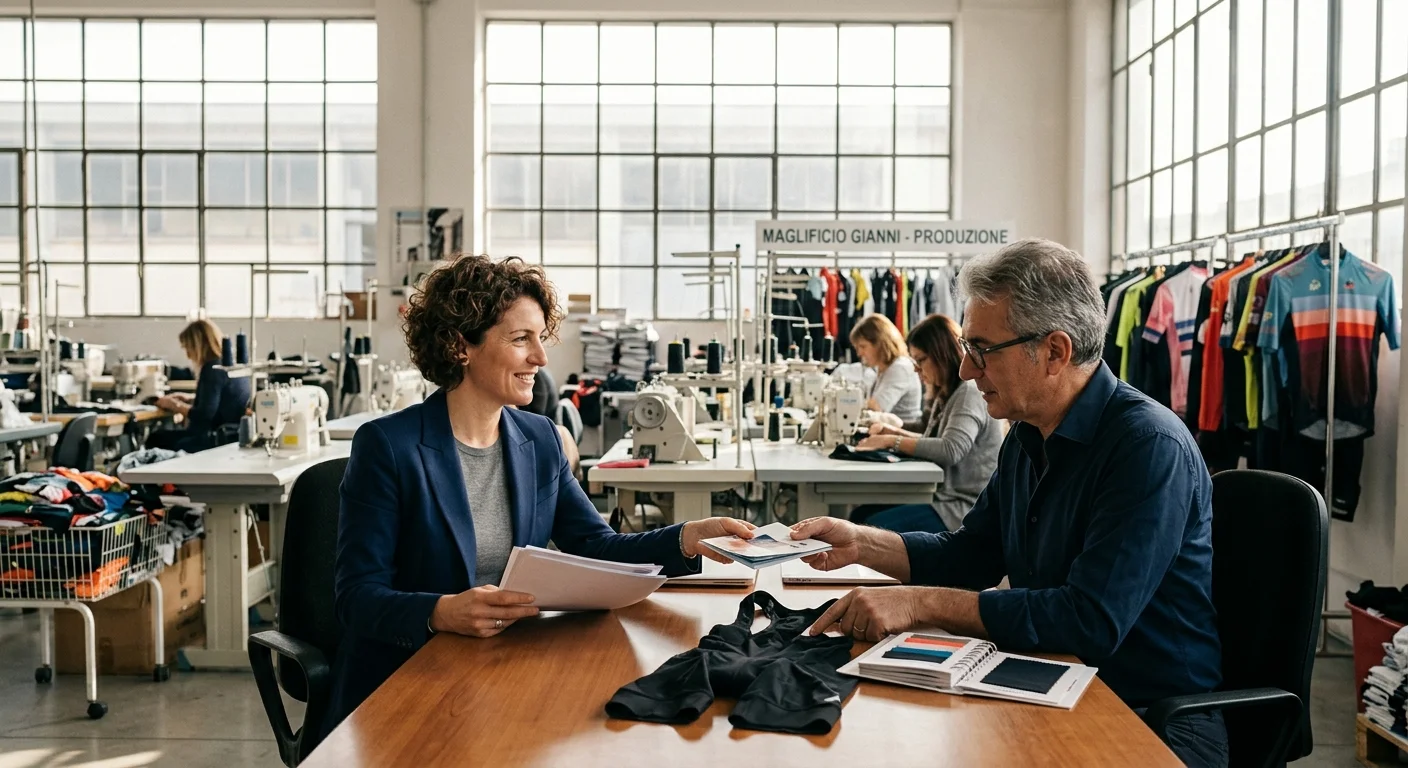
The first email you send to an Italian cycling factory sets a tone that's almost impossible to undo.
Walk in underprepared — no VAT number, no forecast, no tech pack — and the conversation stalls before it starts. Italian manufacturers at this tier work on relationships and signals. A brand with a clear brief gets taken seriously. One without it rarely gets a second response.
Here's the sequence that works.
Step 1: Build Your Intake Package Before You Reach Out
Before contacting anyone, have these ready:
Brand brief : market positioning (race / endurance / lifestyle), target MSRP (premium Italian jerseys retail €110–€180; bibs €150–€260), and target geographies — EU, US, and Asian markets each carry different labeling requirements
Business credentials : company VAT/EORI number, billing address, website or brand deck
Initial forecast : styles × colors × sizes × 2–3 seasons. Even a rough number signals you're a real buyer
MOQ thresholds to plan around: most mid-tier Italian factories start at 50–100 pieces per style per color . Smaller workshops may accept 20–50 pieces , but unit prices go up at that scale. For full custom team kits, expect a 100–300 piece project minimum across all categories.
Step 2: Sign the NDA First — Before Anything Sensitive Moves
Italian OEM factories won't share proprietary patterns, chamois construction specs, or sublimation files without a mutual NDA in place. Standard agreements cover:
Italian jurisdiction
Non-solicitation of factory staff and sub-suppliers
IP ownership over co-developed patterns, graphics, and custom chamois built with suppliers like Elastic Interface
Get this signed before sending artwork. That step gets skipped all the time. It creates real problems later.
Step 3: Request the MOQ Tier Sheet and Swatch Book
Two documents define your cost picture before sampling begins:
MOQ tier sheet : price and lead time per quantity band — 50 / 100 / 200 pieces per style, with ex-works pricing at each tier
Fabric swatch book : Italian mill swatches from Carvico, Miti, or Sitip, with GSM ranges (110–140 gsm for summer jerseys; 180–220 gsm for compressive bib fabric), composition (78% PA / 22% EA is standard), and recommended usage by panel zone
Lock your fabric choice here. Changing it after proto sampling costs time and money.
Step 4: Submit a Complete Tech Pack
Italian factories expect specifics. A vague brief produces a vague sample.
Your tech pack needs:
Graded spec sheet : key measurements XS–XXL with tolerances of ±0.5–1.0 cm at critical points
Flat sketches : front, back, side with full panel breakdown — aero jerseys often run 8–12 panels
Pantone codes : TCX/TPX for dyed fabrics; C/U for sublimation colors
Artwork files : AI or EPS, 1:1 scale, vectorized logos, defined seam and zipper margins
Chamois spec : Elastic Interface model code (road / gravel / women-specific), foam density, layering configuration
Factory technicians will check your files for panel stretch direction, sublimation limits by fabric type, and heat-transfer logo compatibility. Catch these issues on paper. Don't wait for a physical sample to find them.
Step 5: Proto Sample → Fit Session → Pilot Batch
Proto (P1): One size — medium is standard. This checks silhouette, fabric hand, and construction logic. Sampling fees run 1.5–3× the FOB unit cost . Most factories credit this against orders over 200 pieces per style.
Fit testing: Put the sample on actual riders in the drops position. Check sleeve ride-up, bib strap tension across the shoulder, and back pocket behavior under load. Typical adjustment ranges:
Sleeve circumference: ±0.5–1.0 cm
Bib strap height: ±1–2 cm
Chamois placement: shift 5–10 mm forward or back to match saddle position
Pilot batch: 30–50 units run on the actual production line with final fabrics and print settings. This step confirms sewing times, line balancing, and cross-panel color consistency. Do this before committing to bulk.
Step 6: Bulk Production and QC Checkpoints
After pilot approval, bulk lead times for Made-in-Italy cycling apparel run:
Basic styles (200–500 pcs): 30–45 days once materials are in-house
Complex multilayer or thermal jackets: 45–60 days
QC standards to hold the factory to:
Stitch integrity: 8–12 SPI on stretch seams, zero skipped stitches
Color fastness to washing (ISO 105-C06): minimum Grade 4
Logo alignment tolerance: ±2–3 mm against approved sample
Pre-shipment inspection: AQL 2.5, General Inspection Level II — for a 500-piece lot, that means pulling around 80 units for review
The pilot reveals issues? Require a Corrective Action Report (CAR) with root cause and preventive actions documented. Get that before bulk proceeds.
Step 7: Logistics and the "Made in Italy" Paper Trail
Common INCOTERMS with Italian factories: EXW (buyer arranges pickup) or FOB from Venice, Trieste, or Genoa. The "Made in Italy" label holds when substantial transformation — cut and sew — takes place in Italy and gets documented with Italian-sourced materials. For export, you need a Commercial Invoice, Packing List, and Certificate of Origin (EUR.1 or REX statement for EU trade preference claims). Performance cycling apparel falls under HS codes 61.13 / 62.11 . That code directly affects duty rates into the US and EU markets, so confirm it early.
The brands that move fastest through this process aren't the ones with the biggest budgets. They're the ones who did the intake work before the first email went out.
Sourcing directly? See our OEM/ODM Cycling Apparel Manufacturing program for MOQ, lead times and private label options.
Conclusion
The right Italian factory isn't just found — it's chosen . Think of it like a serious cyclist picking a saddle. You go through knowledge, fit, and an honest look at where your brand stands right now.
This guide gave you a clear starting point. You're no longer staring at a blank screen, unsure which Made in Italy cycling wear manufacturer even takes OEM inquiries. You have a working shortlist. You have a feel for each factory's style and personality. You also have a realistic picture of what your budget and MOQ can get you at this stage.
Here's what matters most: don't wait until everything feels perfect. Start the conversation now. Send the inquiry. Request the sample kit. The Italian manufacturers who build strong, lasting partnerships with private label cycling clothing brands say the same thing over and over — the brands they grow with are the ones who showed up early. They asked sharp questions. They treated the relationship like a long ride, not a short sprint.
Pick two factories from your shortlist. Reach out this week.